
The Modernization of Cosmetics Regulation Act (MoCRA) is here to stay. While some requirements continue to be refined through FDA rulemaking, companies must comply with key obligations such as facility registration, product listing, safety substantiation and adverse event reporting. The following 10 steps provide a practical approach to establishing and maintaining MoCRA compliance.
The best way to avoid reacting to individual deadlines is to understand the requirements and follow these 10 practical steps to manage product information and to assess and monitor product compliance and safety.
MoCRA and how to keep your cosmetic products compliant in the US ?
Selling cosmetic products on the US market requires compliance with the regulatory requirements established by the U.S. Food and Drug Administration (FDA).
Since the Modernization of Cosmetics Regulation Act (MoCRA) of 2022 was signed into law, it as has significantly changed the regulatory framework for cosmetic products marketed in the USA. While key requirements such as facility registration, product listing, safety substantiation and adverse event reporting are already in force, the FDA continues to develop additional rules and guidance in areas such as Good Manufacturing Practice (GMP), fragrance allergen labelling and other requirements.
In addition to the federal requirements under MoCRA, individual states may introduce additional obligations, such as California’s Proposition 65 and state-specific ingredient restrictions. Companies marketing cosmetics in the USA therefore need to monitor both federal and state legislation to maintain compliance.
timeline table to be updated
From an “ad-hoc” approach to a “system” approach in 10 steps
Instead of rushing from one regulatory deadline to another and troubleshooting individual requirements on an “ad-hoc” basis, adopt a structured, efficient and proven approach. Our practical and comprehensive 10 key steps framework helps you to manage cosmetics compliance and safety in practice under MoCRA and state level regulations.
Key steps to manage product information
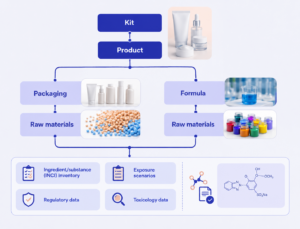
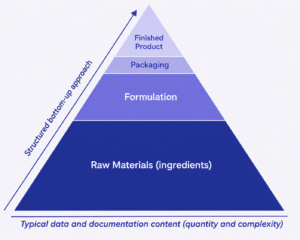
- Build your product compositions bottom-up in a database structure. Start with the raw material compositions as the basic building blocks for your formulations and products. Work with the official INCI substance names and exact percentages and values.
- Link your raw materials to your formulations, and your formulations and packaging components to your products without copying data and documents (one to many approach) to ensure traceability and efficient update/change management.
- Ensure adequate and up-to-date document management. Store technical documentation for each specification (e.g. Certificates of Analysis, stability and preservation efficacy test results, artwork of product labels). Make sure you have dossier completeness and validity date checks in place.
- Work with one-version only for each individual specification (no copies). Ensure appropriate change management with versioning to enable updating specifications while keeping history and traceability over time.
- Create a central (shared) working environment with pre-assigned roles and access rights. Avoid sharing or storing outdated copies of data and documentation across different departments.
5 key steps to assess and continuously monitor compliance and safety
1. Maintain an up-to-date regulatory database and work with correct threshold values per substance, and when relevant, differentiated for each cosmetic product category. Add regulatory data for all countries/regions where your portfolio is sold. Make sure to timely include updated regulatory data from upcoming regulation amendments.
2. Have your toxicology database in place, containing toxicology data for all substances in your product portfolio, and work with exact safety thresholds (toxicological endpoints) and clear literature references.
3. Classify each product in your portfolio according to its respective cosmetic product type based on the intended use, product description/presentation and efficacy claims.
4. Work with predefined (standardised) exposure scenarios for each cosmetic product type in your product portfolio (e.g., shampoo, mascara, face cream, hair dye) for the compliance assessment and safety substantiation.
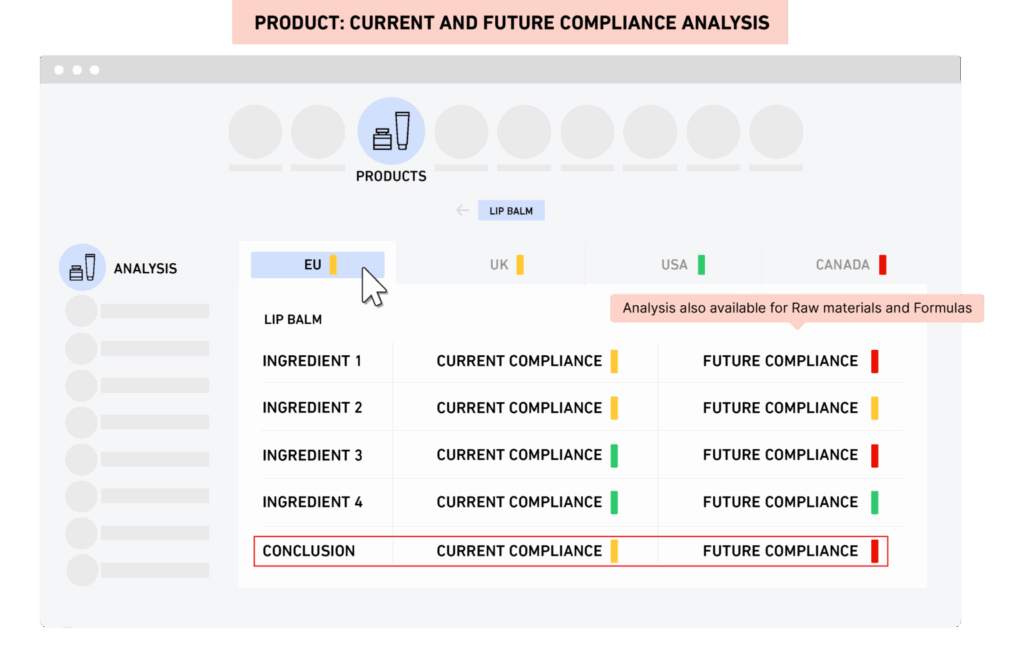
5. Cross-check the exact product composition against your regulatory and toxicology databases based on the exposure scenario that applies for the specific product type. Ideally you should work with a “live dashboard” with a 24/7 real-time compliance status overview for each product in your current and NPD portfolio.
How do these key principles help you to meet the MoCRA requirements in practice?
Instead of meeting individual requirements “ad hoc” as they arise, it is much more efficient and future proof to follow this approach. By implementing these 10 key steps you establish the processes, documentation and controls needed to meet the core MoCRA requirements. Below are some examples for each MoCRA requirement:
- Product listing. The product listing and updates thereof must include, the category code, all ingredients, and whether or not the formula contains fragrances and/or flavours. This information is automatically available when product compositions are built from raw material data and each product is classified with its respective cosmetic category in the compliance and safety assessment. Fragrance and/or flavours (including allergens levels) information flows automatically from the raw material and formulation data.
- Facility registration. Each facility (if not exempted) must register with the FDA, and for each individual brand, the cosmetic product types produced at that facility must be listed. In this 10 steps approach, the facility information including the FEI number is compiled and stored for each facility and linked to each product. Reports that list the products and their respective cosmetic category per facility are easily generated.
- Adverse Events Management. Key elements of adverse events management are the detailed collection of information related to the event, relating this information to the product information that you have stored, combining both to perform the root-cause analysis, and storing the findings in your reporting files for the product. This information is easily pulled together / retrieved, and findings conveniently stored with the product details.
- Safety Substantiation. The EU/UK approach to safety substantiation is generally considered adequate under MoCRA until defined otherwise by the FDA. The detailed safety substantiation is the result of the automatic cross-check of your product data and product type against the regulatory and toxicology databases.
- Label content. Product labels must comply with the labelling requirements of the Federal Food, Drug, and Cosmetic (FD&C) Act, the Fair Packaging and Labeling (FP&L) Act, and the regulations published by the Food and Drug Administration under the Authority of these two laws. The exact information that needs to be included on the product packaging and/or container is easily extracted into a so called US Regulatory Content Brief (RCB).

Conclusion / Insight
Carefully implementing these 10 key steps puts you in control, and exactly where you want to be to meet the MoCRA requirements. It is a “system” approach as opposed to a more “ad-hoc” approach, and results in efficiently and effectively meeting current and future MoCRA and additional state-level requirements.

