
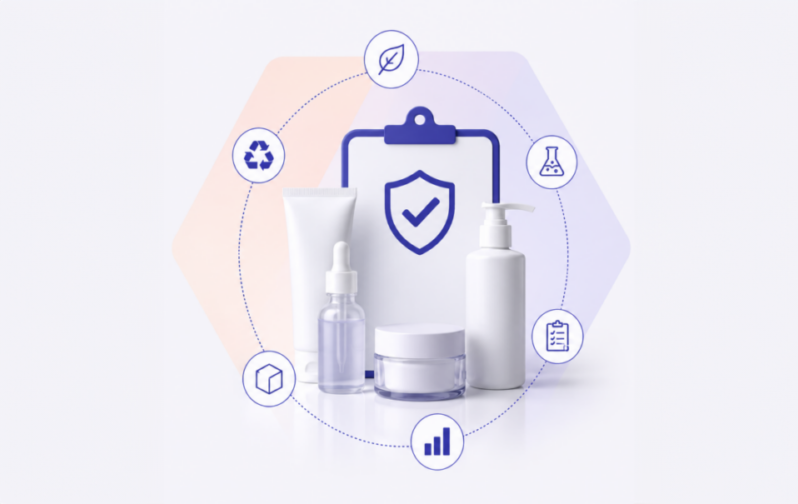
What cosmetic brands and manufacturers need to prepare for – and how structured data can make compliance manageable.
The EU Packaging and Packaging Waste Regulation, Regulation (EU) 2025/40 (PPWR), changes the way companies must manage packaging compliance. For cosmetic manufacturers and brands, packaging will no longer be treated mainly as a purchasing and/or waste-reporting matter. It becomes a documented product-compliance topic, supported by technical data, defined responsibilities and controlled evidence; comparable to PIF.
The Regulation generally applies from 12 August 2026, with several technical requirements introduced in phases. The work should start now because packaging information is generally fragmented across suppliers, specifications, spreadsheets, EPR reports and artwork files.
More than EPR
Many companies associate packaging compliance mainly with Extended Producer Responsibility (EPR): registration, reporting packaging quantities and paying national fees. These obligations remain important, but the PPWR goes further.
It introduces requirements for substances, recyclability, recycled content, minimization and reduction of empty volume, reuse and refill, harmonised labelling, technical documentation, conformity assessment, an EU Declaration of Conformity and national producer registration.
The practical consequence is that packaging compliance must be managed before the product is placed on the market, from the NPD phase throughout the entire product lifecycle, and not only after the packaging becomes waste.
Packaging now requires a compliance file (conformity evidence)
Manufacturers must be able to demonstrate that packaging meets the applicable PPWR requirements. For cosmetic brands, reliable data should therefore be available for every packaging component and finished product, including:
- component, supplier and version identification;
- material composition (incl. coatings, inks, adhesives, labels and closures);
- component and total packaging weights and dimensions;
- recycled-content and recyclability evidence;
- restricted-substance declarations and technical certificates;
- a packaging bill of materials linked to the finished-product SKU;
- national EPR categories, registration status and reporting data.
Without this data, companies will struggle to prepare conformity documentation, substantiate environmental claims, answer distributor questionnaires or complete EPR reports consistently. This very much aligns with PIF management approach, a familiar concept for cosmetic brands and manufacturers.
The key risk is fragmented information
Most companies already hold part of the required information. The problem is that it is stored in different places, owned by different departments and not reliably connected to the current product version.
A specification may sit with procurement, artwork with marketing, EPR weights with finance, supplier declarations with quality and the product file with regulatory. When one component changes, there is often no single process that determines whether the technical file, label, environmental claim, EPR report or market status must also change.
PPWR compliance is therefore a data-governance challenge as much as a legal one.
TRC approach: structured PPWR data and documentation management in PRIMS
TRC approaches PPWR through the same principles that support reliable cosmetic compliance: structured data, controlled documentation, traceability and change management, fully integrated and aligned with PIF.
Within PRIMS, packaging can be managed through one centrally controlled master-data record linked to specific products and their market versions. This allows companies to:
- record the complete packaging bill of materials and component-level data;
- store supplier specifications, declarations, certificates and technical evidence;
- link packaging components to the correct product and market versions;
- document conformity assessments and EU Declaration of Conformity inputs;
- identify missing data and trigger reassessment when a material, supplier, weight, label or component changes;
- produce consistent outputs for clients, distributors, authorities and EPR schemes.
The objective is not to create another isolated packaging file. It is to integrate packaging into the same controlled compliance environment as the cosmetic product itself.

What companies should do now
- Map the PPWR roles and identify the EPR producer in each EU market.
- Create a packaging bill of materials for every product.
- Request structured packaging data and evidence from suppliers.
- Connect packaging specifications to product and artwork versions.
- Introduce formal change control for packaging modifications.
- Review current environmental claims and recycling statements and align them with available evidence.
- Build a phased implementation roadmap for the 2026-2040 obligations.
Under the PPWR, packaging must be managed as a controlled and documented element of the product. Companies that organise their packaging data now will be better prepared for conformity assessment, EPR reporting, customer requests and future regulatory changes.
Reference: Regulation (EU) 2025/40 of the European Parliament and of the Council of 19 December 2024 on packaging and packaging waste.

